advertisement



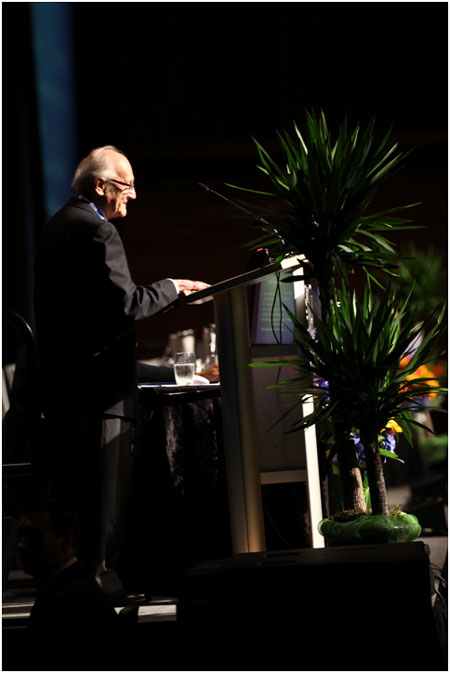
Keynote Lecture by professor Emeritus Stephen Michael Drance
Balwantray Chauhan
A highlight of the 2013 World Glaucoma Congress was the Keynote Lecture delivered by Stephen Drance entitled, "My Personal 60-year Glaucoma Odyssey." Dr. Drance has spent most of his ophthalmological career in Vancouver and therefore it was fitting that as one of the most prominent clinician-scientist in our field, he was selected Keynote Lecturer. The lecture was delivered as part of the Opening Session.
One of Dr. Drance's major contributions has been in perimetry. He recalled being taught the art of quantitative perimetry by H.M. Traquair (1875-1954) in Edinburgh. Stephen's subsequent contributions to perimetry extended well into the era of modern automated perimetry, with Anders Heijl and Josef Flammer, key pioneers of computerized perimetry both undertaking fellowships in Vancouver under Dr. Drance. With Ronald Lakowski, he conducted research on the earliest psychophysical disturbances in glaucoma and cautioned, even in the early 1980's, that while there were patients with elevated IOP and normal standard perimetric findings with acquired colour vision defects, others with advanced visual field loss had normal colour vision. These findings hinted at a dissociation of functional abnormalities that may have their origin in different mechanisms leading to what we collectively term open-angle glaucoma. These ideas were further supported by his description (along with Drs Spaeth, Geijjssen and Greve) of distinct optic disc phenotypes in glaucoma and their statistically different associations that hinted at multiple mechanisms leading to glaucomatous optic neuropathy.
The Collaborative Normal Tension Glaucoma Study (CNTGS), spearheaded by Drs. Drance and Douglas Anderson, was the first published trial with randomized treated and non-treated arms in patients with established glaucoma. This landmark trial found that even in patients with so-called normal tension glaucoma, IOP reduction was beneficial in diminishing the incidence of visual field and optic disc progression. Subsequent evidence from the two other major randomized trials with a non-treated arm (i.e. the Ocular Hypertension Treatment Study and the Early Manifest Glaucoma Trial) unequivocally supported the notion that IOP was an important pathogenic factor across the spectrum of IOP. Nonetheless Dr. Drance emphasized that the CNTGS revealed two other major findings; first, that there were other important risk factors that were associated with progression and second, that many patients randomized to non-treatment showed no progression. He argued the case for withholding treatment in most of such glaucoma patients until they showed signs of progression. This notion was supported by previous findings in the 1970's when he proposed that newly diagnosed patients with a history of major shock-like hemodynamic crises rarely progressed and that signs of glaucomatous progression were necessary before initiating treatment. He emphasized that while we should continue to search for other treatable risk factors in glaucoma, the role of IOP was unquestionable.
Throughout his lecture, Dr. Drance emphasized the importance of thinking outside of the box. He reiterated that what one does not look for, one will not find. After his 1982 Bowman Lecture, Roger Hitchings commented, "For decades clinicians have been single-mindedly following one idea, namely that elevated IOP was the sole problem in glaucoma to the exclusion of all others. It needed de Bono-like thinking [Edward de Bono coined the term "lateral thinking"] to escape from the trough of this ideology and generate fresh ideas. In this Bowman Lecture, Stephen Drance has demonstrated this freedom." Stephen found this quotation summarizing his approach and views on glaucoma important enough to share with the WGC audience.
It would be difficult for most people, let alone Dr. Drance, to do full justice to a research career that spanned 60 years within the confines of a single lecture, however, Stephen did touch on topics that have interested him the most, each time with funny anecdotes that give these discoveries a wonderful human touch.
In the mid-70's Hans Goldmann was asked to travel to California from Berne, Switzerland to give his opinion on the (at the time controversial) glaucoma treatment paradigms attributed to Stephen, Mansour Armaly and others. To the surprise of most participants at the meeting, Dr. Goldmann discarded his prepared notes and said that he had heard nothing with which he disagreed. Stephen recalled being annoyed at why a 75-year old man was asked to cross to Atlantic Ocean for apparently false pretenses. Nonetheless, these feelings dissipated after a visit to the Playboy Club in Beverley Hills where a good time was had by all. Stephen is now 88 years old and thinks that it was not at all unreasonable to ask Goldmann to cross the Atlantic as he was a relatively young man!
I have often heard Stephen describe the "rediscovery" of the optic disc haemorrhage by him and his fellow Fred Feldman, but it is a joy to listen to it each time. When the penny dropped, he recalled Fred rushing into his clinic as one of his patients had a red comma like streak at the edge of the disc which was frequently noted optic disc drawings in patient charts, but without further questioning. Within a week, they saw at least 10 more disc haemorrhages and on review of disc photographs there was no shortage of them. Stephen has never warmed to a haemorrhage being named after him and quickly corrects anyone who uses the term "Drance haemorrhage"! He always points out that the disc haemorrhage in glaucoma was first described by Bjerrum in 1899, but that his paper, in Danish, languished on the bookshelves for decades afterwards.
Stephen delivered the Lecture with his usual flair, his concise and precise use of language combined with his trademark cheeky sense of humour. After a rather elaborate but genuine introduction by Dr. Gordon Douglas in which so many of Stephen's virtues were extolled, with a deadpan face Stephen responded, "Gordon, may the good Lord forgive you for this flowery introduction and may he forgive me for enjoying it."